News
The Feast of “Madonna della Salute” in Venice: history, traditions and things to see on 21 November
21/11/2026
Every year on 21 November, Venice celebrates one of the most deeply cherished events in its history: the Feast of Our Lady of Health. This special occasion brings together faith, tradition and Venetian identity, attracting residents and visitors to the magnificent Basilica of Santa Maria della Salute. Discover the origins of this celebration and how to experience Venice during one of its most significant annual events.
Venice is a city rich in traditions, popular celebrations and festivities that tell the story of its past. Among them, the Feast of Our Lady of Health holds a very special place in the hearts of Venetians.
Every 21 November, thousands of people cross the Grand Canal to reach the Basilica della Salute and pay homage to the Virgin Mary. It is a day when the city rediscovers its connection with history, spirituality and popular traditions, keeping alive a ritual that has been passed down for almost four centuries.
Visiting Venice during the Feast of Our Lady of Health means discovering a more authentic side of the city, taking part in one of its most distinctive celebrations and experiencing an atmosphere quite different from that of the usual tourist itineraries.
To understand the significance of this celebration, we need to go back to 1630, when Venice was struck by a terrible plague epidemic that claimed thousands of lives.
The disease spread rapidly throughout the city, causing suffering and fear among the population. Faced with the severity of the situation, the government of the Republic of Venice, under Doge Nicolò Contarini, made a solemn vow to the Virgin Mary: if the city were freed from the plague, a magnificent church would be built in her honour.
When the epidemic came to an end in 1631, the vow was fulfilled.
The construction of the Basilica of Santa Maria della Salute was entrusted to architect Baldassare Longhena, who designed a monumental building that would become one of the most recognisable landmarks of the Venetian skyline.
The basilica was built at the entrance to the Grand Canal, in a spectacular location that remains one of the city’s most iconic views.
Since then, every 21 November, Venice has renewed its vow through a celebration that commemorates the end of the plague and the city’s profound bond with Our Lady of Health.
One of the most distinctive features of the Feast of Our Lady of Health is the temporary votive bridge built across the Grand Canal to allow worshippers to reach the basilica.
This temporary pedestrian bridge connects the two banks of the canal, running from the Santa Maria del Giglio area to the church.
Crossing it is a special experience, particularly in the early morning, when many Venetians set off on foot to reach the basilica.
The bridge becomes a visible symbol of a shared tradition: a route that brings the city and its people together through an act of devotion repeated for generations.
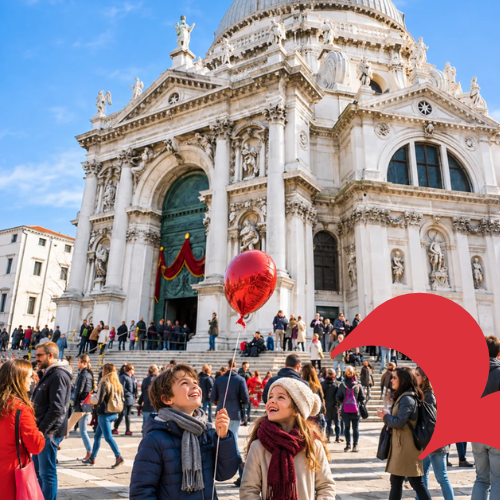
The focus of the Feast of Our Lady of Health is the magnificent Basilica of Santa Maria della Salute, one of the most important and recognisable religious buildings in Venice.
Designed by Baldassare Longhena and characterised by its large octagonal floor plan, the basilica stands out for its imposing dome, external volutes and privileged position at the entrance to the Grand Canal.
Inside, visitors can admire important works of art, including paintings by Titian and a celebrated cycle of works by Jacopo Tintoretto.
During the festival, the basilica becomes the centre of religious celebrations. Worshippers enter to pray, light a candle and offer a thought to the Virgin Mary, renewing a gesture that has become part of the city’s collective memory.
Even for visitors who are not travelling for religious reasons, 21 November is a special opportunity to discover Venetian history and culture up close.
The Feast of Our Lady of Health is not only a religious celebration but also an occasion closely linked to Venetian food traditions.
The traditional dish of the day is castradina, an ancient recipe made with salted, smoked and dried mutton, slowly cooked with savoy cabbage and onions.
According to tradition, during the plague epidemic of the seventeenth century, preserved meat brought from Dalmatia became an important food resource for the people of Venice.
Over time, castradina became the traditional dish served on 21 November. It is still prepared today in some Venetian households and served in traditional restaurants that keep the city’s culinary heritage alive.
Tasting it means discovering another aspect of Venetian culture, where food preserves the memory of historical events and centuries-old customs.
The Feast of Our Lady of Health is a wonderful opportunity to spend a day in Venice and discover some of its most fascinating places.
Here are some experiences not to be missed:
The festival is also an opportunity to move away from the busiest tourist routes and experience the city through the eyes of those who live there every day.
November is a particularly atmospheric month to visit Venice. Quieter days, autumn light and the unique mood of the lagoon offer an experience quite different from the busiest tourist periods.
The Feast of Our Lady of Health is one of the most significant events in the Venetian calendar and can be the perfect reason to plan a weekend in the city.
Alongside the celebrations, visitors can explore museums, historic palaces, exhibitions and lesser-known neighbourhoods.
And for those who would like to experience Venice while enjoying a more peaceful setting, the Lido offers a pleasant alternative to the historic centre.
If you are planning to attend the Feast of Our Lady of Health and discover Venice in November, Russo Palace Hotel, on the Lido of Venice, is an ideal choice for a stay dedicated to culture and discovery.
Set in a historic Liberty-style villa, the hotel welcomes guests into an elegant atmosphere where the charm of Venetian architecture meets the comfort of a relaxing stay.
Choosing the Lido means experiencing a different side of the city: quieter and more relaxed, yet well connected to the historic centre by public water transport.
From the Lido, you can easily reach Venice, visit the Basilica della Salute, take part in the celebrations on 21 November and continue your day exploring the city’s narrow streets and picturesque squares.
After a day spent discovering Venetian traditions, Russo Palace Hotel is the perfect place to unwind and enjoy your stay.
The Feast of Our Lady of Health is much more than a religious celebration: it tells the story of Venice, its ability to overcome difficult times and the deep bond between the city and its people.
21 November is the perfect opportunity to discover an authentic side of Venice, through traditions passed down through generations, local flavours and places steeped in history.
Book your stay at Russo Palace Hotel and experience Venice during one of the celebrations most loved by its residents.